This short video explains how to use the YouTube Video Targeting Tool, a new Google ads feature.
Access the YouTube Video Targeting Tool by going to http://www.Google.com/videotargeting
This short video explains how to use the YouTube Video Targeting Tool, a new Google ads feature.
Access the YouTube Video Targeting Tool by going to http://www.Google.com/videotargeting
I found the following email in the Spam folder of my Gmail Account this morning.
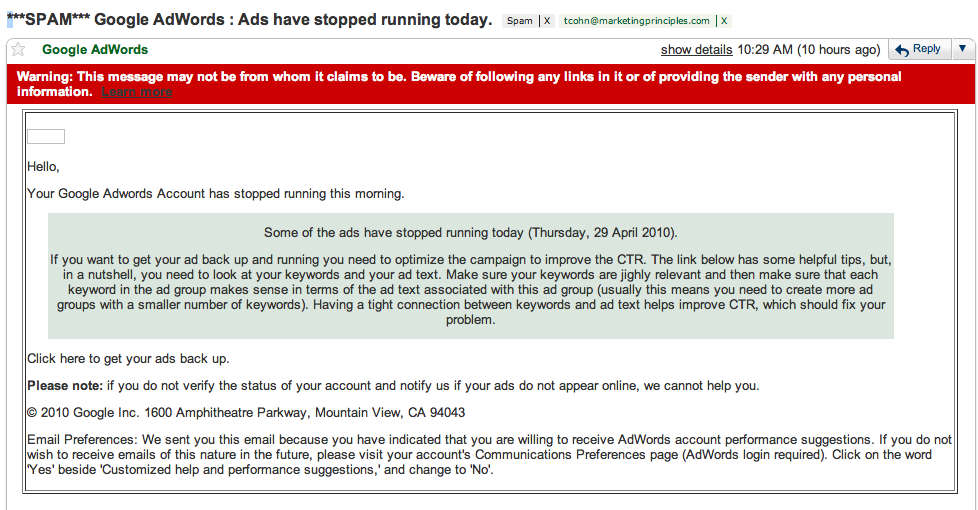
Sample Adwords Phishing Attempt
Fortunately for me and all the other Google Adwords advertisers who use Gmail, Google is able to identify and flag nefarious phishing acts like this one featured in the above email.
From the Nielsen Company:
Top Ten Search Providers March 2010
Searches represent the total number of queries conducted at the provider. Example: An estimated 6.4 billion search queries were conducted at Google Search, representing 65.7 percent of all search queries conducted during the given time period.
Note: MegaView Search data – including total searches, unique searchers, search share, and all other search figures – cannot be trended with search results prior to October 2009 due to recent methodology changes.
Try the new Google Place Pages for mobile.
See the hours, dynamic maps, and what people are saying about local businesses.
Just go to Google.com on your iPhone 3.0+ or Android 2.0+ phone, search for a business, and click on the local listing for the business in the search results.
For simplicity’s sake, word of mouth marketing messages occur in one of two forms: positive or negative.
To marketers’ dismay, negative word of mouth messaging propagates much like its cousin “bad news”.

Word Of Mouth
Companies, marketers and salesman only wish they could be so lucky to have the good news about their product spread so easily.
Problem is in order to get the good news spread about a company or its products – they must be remarkable enough to talk about in the first place.
Fact is few companies are.
Those companies that are understand positive word of mouth marketing is woven into the company’s DNA or its not.
I would guess for every fifty marketers familiar with negative word of mouth and attempts to stem it there might be two fortunate marketers from companies with “good DNA” versed in the creation and distribution of positive word of mouth.
Why?
Negative word of mouth occurs as a result of market mediocrity and thus statistical probability.
After a company reaches a sizable market share and number of employees, the likelihood that one of its employees and or its products will fail to meet customer expectations grows correspondingly.
Hence, the potential for negative word of mouth.
Today I experienced just such a case.
A contractor was in my home programming remote controls that required the use of a laptop.
When I asked where his laptop was, he said – “Well I have a $2,700 Dell laptop in the truck but it doesn’t work anymore. I had it for a year and it worked beautifully then it just stopped working. It got too hot and just shut down. I have tried to get it replaced but I hate calling them. I will never buy a Dell computer again.”
What’s interesting about this particular case of negative word of mouth is I didn’t ask the contractor for his opinion about Dell or laptop computers for that matter, he just shared them with me – unsolicited.
The problem for Dell and other large companies like them is that they rarely listen for let alone hear this type of customer feedback.
Worse yet, they’re unaware why they won’t get the contractor back again as a customer.
Large mediocre companies may incur negative word of mouth out of statistical probability but few if any companies can incur and ignore large quantities of negative word of mouth without suffering measurable consequences.
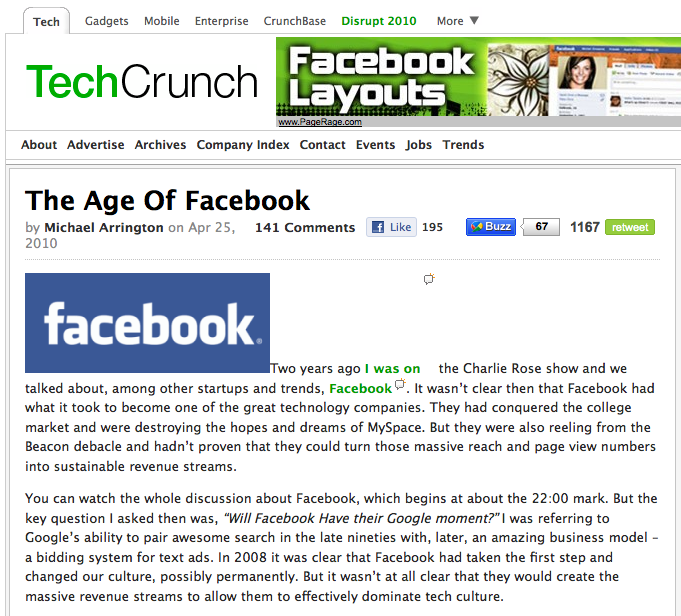
Had Techcrunch ever left you wondering as to whether or not their editorial voice was for sale, today they eliminated any doubt with the following Facebook fanboy headline: The Age of Facebook.
The Age Of Facebook
If this is the age of Facebook, then why must Facebook tell us so?
Learn how to choose and review keywords in a Google Adwords account with these three simple steps to keyword success.
Charles M. Berger former brand marketer for H. J. Heinz Co. and CEO of Scotts Miracle-Gro Co. defined a brand as follows:
“A real brand owns a very tiny but important piece of real estate in a consumer’s mind.”
Toward that end, BrandTags.net has developed an online brand association tool for identifying the pieces of real estate a particular brand owns in the minds of consumers.
If Mr. Berger were still alive, I am sure he would be pleased to learn his previous employer H.J. Heinz and their primary product – Ketchup – still own the generic product category description in the vast majority of consumers’ minds (at least those who visited and tagged brands at BrandTags.net ).

BrandTags.net
From eMarketer:
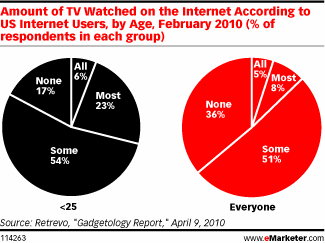
The advantages of watching television shows online are straightforward. When comScore asked cross-platform TV viewers in December 2009 which factors would make them choose to watch online, being able to watch wherever and whenever they wanted, as well as to pause and play shows at will, were the top reasons.
But the “overall viewing experience” still tilted in television’s favor, and younger adults remain the most likely group to watch TV shows on the Web.
According to consumer electronics site Retrevo’s “Gadgetology Report,” 23% of Internet users under 25 watched “most” of their TV on the Internet, compared with 8% of all online adults. Under-25s were also less than one-half as likely to say they watched no TV on the Web.
Web TV Views
While the days of Network and Cable TV may not yet be numbered, the days of Packet TV are here to stay.
 Tim Cohn Flickr Feed
 @TimCohn | Author Tim Cohn's Blog