I am taking several days “off” from the day to day grind to “recharge my batteries, … shut down the engines, and get myself back to neutral.”
Not surprisingly, being in this environment hasn’t taken any time at all to get myself back to neutral…
In this video Peter Robinson of the Hoover Institution interviews Rupert Murdoch.
Murdoch owns the controlling interest in News Corporation, which in turn owns media properties on five continents — properties that include some 170 newspapers, dozens of television stations, half a dozen television networks, a publishing company, and a movie studio.
Murdoch discusses his media empire and the current state of the newspaper business, as well as other issues on Uncommon Knowledge.
Murdoch’s best quote is at 9:13 into the video in response to Dan Rather’s plea for a government bailout of the press.
Murdoch says – “I think you’re talking rubbish… we don’t want government money in that we want a free press.”
It has been several years since I looked at any site’s Alexa ranking.
I was surprised to find Alexa has come along way in surfacing their data and making it much more attractive and user friendly.
Alexa now provides deeper insight into each domain’s search audience and traffic.
Alexa also makes their data available in Simplified Chinese.
comScore released their January 2010 Video Metrix service data showing that nearly 173 million U.S. Internet users watched online video during the month.
Video viewers at YouTube.com watched 93 videos on average during the month, representing an increase of 50 percent versus year ago.
From comScore:
U.S. Internet users watched 32.4 billion videos in January with Google Sites ranking as the top U.S. video property with 12.8 billion videos. YouTube.com accounted for nearly 99 percent of all videos viewed at the property. Hulu ranked second with 903.1 million videos, or 2.8 percent of the all online videos viewed. Microsoft Sites ranked third with 491.8 million (1.5 percent), followed by Yahoo! Sites with 435.5 million (1.3 percent) and Viacom Digital with 361.2 million (1.1 percent).
Top 10 Video Content Properties by Videos Viewed
Google sites share of online videos viewed continues to dwarf all other online video sources combined by roughly a factor of four.
Video views in the U.S. have now surpassed 100 per month per capita.
I ran my longest run so far in 2010 today- 14.53 miles.
Although I have driven and measured a 5 mile course several times with my car’s odometer, my iPhone’s GPS Running App from RunKeeper reports the distance is one half mile shorter than what my car reported.
I think I ran closer to 15 miles but at this point I am just glad I got it done.
While there may be a great app for recording run data like Runkeeper, I don’t think Apple’s App Store yet offers an app that recharges runners after their long runs.
If there were an app for that – I would buy it!
I was talking to my son today about a vertically integrated restaurant I had been to in London that produced its own game.
It had been several years since I had been there and I was having trouble remembering its name and exactly where it was located.
Our conversation came about because we have a local restaurant chain headquartered here that raises its own dairy cows and beef that it sells in its stores.
I then remembered the London restaurant’s name – Rules.
Rules serves game grown on its privately owned Lartington Estate (farm).
In addition to being a vertically integrated restaurant, it may also be the world’s oldest vertically integrated restaurant because Rules is the oldest restaurant in London.
Rules was established in 1798.
I found Rule’s location in Google but was surprised to find the funky characters below displayed above their Local Business Listing.
A second search wasn’t able to reproduce the same error.
For those of you who have been in the search marketing business for a while, you will be pleased to see Yahoo’s Search Marketing Desktop’s 2010 reincarnation of the Overture Keyword Tool.
Same Yahoo data – 2010 style…
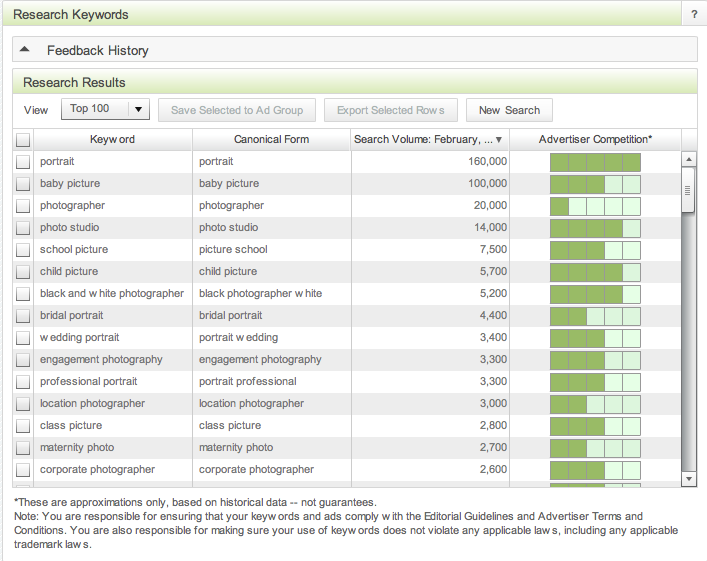
Yahoo’s new “Research Keywords” feature is Ajax based and approaches the research process differently than any other keyword tool I have seen before.
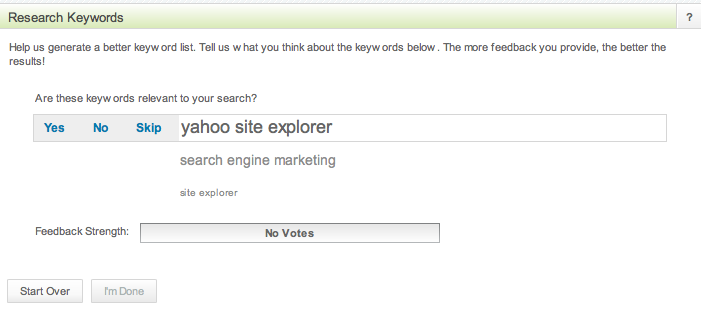
Specifically after entering a url for keyword analysis, Yahoo’s keyword research tool presents a list of potential keyword phrases – one at a time – and then asks users whether the keywords presented are relevant or not.
Users can then select Yes, No or Skip.
While this process of selecting or deselecting keywords one at a time initially seems time consuming, it helps marketers first clarify who their target audiences are and more importantly who they aren’t.
Yahoo’s keyword research tool provides the canonical form of the keyword – which I believe is a first for the keyword tool market- estimated search volume and advertiser competition.
The tool also provides keyword suggestions from the Top 100, Top 500 and Top 1000 results.
I am looking forward to using Yahoo’s Search Marketing Desktop Keyword Research Tool.
Discovering its new features reminds me of the excitement I first felt when I discovered the Overture (Yahoo) Keyword Suggestion Tool.
According to a report from strategy consulting firm AMR International, online B2B spending will recover in 2010 and experience compound annual growth through 2013.
From eMarketer:
The B2B Online Marketing report notes that growth in several areas will exceed the average rate. B2B social media marketing spending will enjoy a CAGR of 21% over the period, while lead generation Websites will increase 17%.
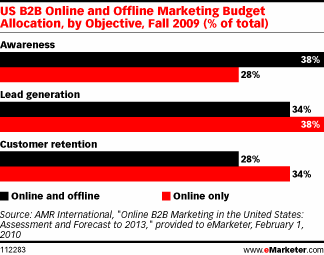
Unlike in media as a whole, where the biggest B2B marketing focus is on building awareness, in the online channel lead generation is the top priority. Customer retention is also more important online, with awareness lagging behind when it comes to divvying up digital budgets.
As an online marketer, I am amazed business to business marketers are still allocating the majority of their media spend to building awareness whether online or off versus focusing exclusively on harvesting leads online.
I guess not all B2B Marketers are aware…
I sent the note below about why a small town should consider applying for Google’s Fiber Trial via email to a small town resident yesterday:
I thought the following might be of interest to you, your company, your contemporaries and the City of X.
“New computing cycles create / destroy material wealth.” Morgan Stanley Research
I read several weeks ago about how Google is planning on awarding an Ultra High-Speed Internet infrastructure project to a small number of trial locations throughout the US.
googleblog.blogspot.com/2010/02/think-big-with-gig-our-experimental.html
At the time, I didn’t think much about their announcement.
However, yesterday I read about how Topeka, KS is planning on submitting an application and then I learned Duluth, MN plans to apply as well.
forbes.com/feeds/ap/2010/02/28/technology-technology-hardware-amp-equipment-us-topeka-google_7393887.html
This morning it occurred to me “your city” would be just as good a trial location for this project as any of the other cities who have publicly announced their intent to apply.
If your city were to apply, the application alone would reflect positively on the city’s leadership.
Winning a project like this would also surely help the city’s employers attract and retain talent while
also insuring future investment and development in the community for years to come.
There probably aren’t any of our towns applying… if any were – why not yours?
Broadband and speeds throttle productivity.
America needs to upgrade our network access speeds to compete with those countries who had the foresight to understand increased and superior network speeds enhance a country’s global competitive advantage.

Below the line spending on Social Media Marketing continues to increase according to a recent CMO Survey from Duke University and the American Marketing Association.
According to eMarketer:
Marketers were already planning on upping spend in August 2009. They have continued to increase outlays since then, with respondents in February 2010 claiming they will devote nearly one-fifth of their marketing budgets to social media in the next five years.
Looking across sectors, business-to-business (B2B) spending is nearly in line with business-to-consumer (B2C), except in the lagging B2B products category. While B2C services were behind the game in August 2009, spending in that area has caught up and will remain in line with other outlays for the next several years. B2B product marketers will remain behind the curve over the next five years.
Notably, spending plans for every sector were higher in February 2010 than they had been just six months earlier.
Growing B2B spending on social media lines up with the general goals of B2B marketers: customer relationship management and brand-building, which respondents claim will be the highest growth areas in the next year. Social marketing, with its strength in boosting brand engagement and loyalty, is an effective medium for both purposes.
While many marketers plan to increase their below the line spending on social media marketing in the coming months and years, an inability to directly measure social media marketing’s performance and return on investment will ultimately keep many a marketers social media plans from reaching an above the line marketing expense.