Archive for April, 2010

Teens And Cell Phones: Text Messaging Tops Usage

April 20, 2010

Text Messaging has become the centerpiece of communication for American Teens.

From the Pew Research Center:

The mobile phone has become the favored communication hub for the majority of American teens.1

Cell-phone texting has become the preferred channel of basic communication between teens and their friends, with cell calling a close second. Some 75% of 12-17 year-olds now own cell phones, up from 45% in 2004. Those phones have become indispensable tools in teen communication patterns. Fully 72% of all teens2 — or 88% of teen cell phone users — are text-messagers. That is a sharp rise from the 51% of teens who were texters in 2006. More than half of teens (54%) are daily texters.

Among all teens, their frequency of use of texting has now overtaken the frequency of every other common form of interaction with their friends (see chart below).

Teen Texting

Teen Texting

Fully two-thirds of teen texters say they are more likely to use their cell phones to text their friends than talk to them to them by cell phone.

One in three teens sends more than 100 text messages a day, or 3000 texts a month.

Learn more about teen communication behaviors and trends from the Pew Research Center.
Just 12 Hours A Day?

April 19, 2010

From eMarketer:

US ad spending was down in 2009 as marketers and consumers alike tightened their belts during the recession. And while Americans looked to save money and trim expenses, they also began to spend less time with media, causing a worse drop in ad spending, according to the Yankee Group.

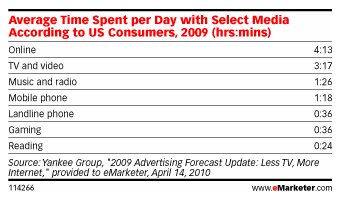
Online was the largest segment of media time in 2009, followed by TV and video, music and radio, and mobile phone usage.

Average Time Spent With Media

Average Time Spent With Media

Overall, US consumers spent less than 12 hours a day with media on average. That was down from nearly 14 hours daily in 2008, a 17% decrease. Yankee Group speculated in its report that the recession may have left Americans too stressed to enjoy as much media consumption as the previous year.

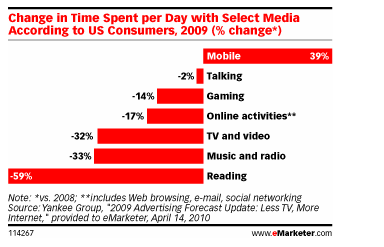
Activities decreased almost across the board, with reading, music and radio, and TV and video dropping most dramatically. The only increase in time spent was with mobile phones. Talk time on mobile was up 12%, while average daily mobile Web use rose 36% to 11 minutes. Texting was also up, by 55%, to take up 27 minutes a day in 2009.

Change In Time Spent Per Day With Media

Change In Time Spent Per Day With Media

Yankee Group’s picture of media consumption differs from others, including Nielsen’s “Three Screen Report.” For Q4 2009, Nielsen reported TV time was up and significantly higher than Internet usage. Nielsen relies on automated data collection, while Yankee Group polled US consumers. In addition, Yankee Group includes both personal and work Internet usage in its media consumption study, while Nielsen excludes work time.

“Yankee Group believes the transparency in our consumer attention model provides a more accurate picture of consumer demand for media, while automated systems are more tuned to determining media supply,” said the report. “As connected devices flourish and multiply in consumers’ lives, we further believe this attention-driven model will rise in importance as consumers struggle with an increasing tyranny of too much media.”

The idea of the average American spending twelve hours a day consuming and using media makes me think a media diet book will soon find an audience and market.

Testing Messaging Online

April 18, 2010

In this video, a political consultant outlines the advantages of using the internet in political campaigns.

The Challenge Of Political Advertising On The Web

April 17, 2010

The pros and cons of traditional advertising vs. online advertising from a political advertising pro’s perspective.

The con of online political advertising?

“….its just not invasive enough, we’re just have problems making sure that it penetrates.”

Listening Is Not Asking

April 16, 2010

Nor is listening hearing…

Half Of Web Traffic Being Accessed From Mobile Devices Vs. The Desktop

April 15, 2010

Alex Barza, Google Mobile Ad Sales Lead, and Surojit Chatterjee, Google Product Manager, present “Mobile as the Next ‘Big Bet'” at Think with Google summit.

During the presentation Barza quotes Morgan Stanley’s prediction that “half of web traffic will one day be accessed from mobile devices vs. the desktop.”

Mobile "Shopping" Category Growth

Mobile "Shopping" Category Growth

The title of their presentation was “Mobile as the next Big Bet”.

From a company known for informing their decisions with data, isn’t their choice of the word “Bet” in their presentation title somewhat odd?

While Morgan Stanley’s prediction i.e., bet that half of all web traffic will eventually come from mobile devices is nothing more than simple arithmetic – I don’t believe Morgan Stanley also said half of all searches will then come from mobile devices too.

Maybe this is why Google perceives Mobile as a “Big Bet” – because the odds are long at best that mobile search will scale along with mobile device (smartphone) penetration.

Even at mobile device (smartphone) market saturation, mobile search volume will not surpass desktop search query volume.

Find People To Follow

April 14, 2010

From the official Google Blog:

This morning we announced a replay feature in real-time search that helps you search the public archive of updates from Twitter. Now, we have more Twitter news from today’s Chirp Conference. We’ve just released a new experimental service in Google Labs called Google Follow Finder to help you expand your Twitter network. With Google Follow Finder, simply enter your Twitter account name and you’ll see a list of people you might be interested in following. You can also get interesting suggestions by entering other Twitter user names. Here’s what it looks like:

If you see someone you want to follow, just click “Follow on Twitter,” log in, and they’ll be added to your following list in Twitter. This integration is based on Twitter’s new @anywhere frameworks, which make it easy for any site to add Twitter functionality. We’re using the frameworks to provide dynamic information about Twitter accounts and one-click following.

Find People To Follow

Find People To Follow

From my perspective, “Find People to Follow” is a great idea executed backwards.

Bing Advertising Ping

April 13, 2010

I got this email from Microsoft today highlighting the merits of the late 2010 Microsoft and Yahoo search alliance integration and launch.

Bing Advertising

Bing Advertising

If I were a gambler, I would wager the integration of Bing’s and Yahoo’s search products won’t meet their stated launch date of “late 2010”.

News Isn’t Transactional For Advertisers

April 12, 2010

I was reading yet another story about how newspapers can be saved by tweaking their business models.

The newspaper industry can tweak their business models all they want, yet as long as Google offers advertisers a more direct method of reaching their audience without having to wrap their sales message in the day’s news, the news – whether online or offline – will continue to illustrate just how ineffective it has been all along at delivering branded sales messages let alone direct sales message performance.

The reality is News as content is no longer the most effective sales message carrier.

No business model can change what has been traditionally considered “news”.

How To Run A Report In Google Adwords

April 11, 2010

In this video learn how to create, customize, and save reports in the Google AdWords Report Center.